I have been telling people that Artemis is the most wholesome obsession I have had in a long time. Bear with me as I reflect a little. It comes back to schools, eventually.
I did not expect to be so moved by a space mission. At a time when so much of what captures our attention feels frantic or cynical, this felt different. It was sincere, funny, and brave, the kind of thing you want to share because it reminds you that not everything vying for our attention has to drain us.
Of course, I understood that the mission was significant. The scale is almost impossible to comprehend: years of planning, thousands of people, a spacecraft traveling around the Moon, and a crew trusting the math, the systems, the training, the vehicle, and one another. What struck me was how human it all felt. Joy kept breaking through.
Rise, the little stuffed Moon that served as the zero-gravity indicator, floated through Orion, designed by an 8-year-old and selected from more than 2,600 entries. Victor playfully spun in circles in the microgravity of the spacecraft. Reid, while orbiting the Moon, was still somehow dealing with the same earthly frustrations the rest of us face at our desks: “I have two Microsoft Outlooks and neither one of those are working,” he told Mission Control. Even space travel, apparently, does not free us from email frustrations.
Joy showed up when “Pink Pony Club” was the wake-up song and it cut off before the chorus. We heard Christina say, “Call them, call them!” meaning Mission Control. She needed more of the song (of course she did). Later, after splashdown, while still inside the spacecraft on the Pacific, she shared M&Ms with the crew she had put in her spacesuit pocket before re-entry. In the middle of heat shields and lunar trajectories and ocean recovery teams, Christina had thought to tuck some M&Ms away to share?! I loved that. It was funny and ordinary and somehow exactly right.
Some of the moments that stayed with me most were the tender ones, the ones that reminded us who was inside the spacecraft. I was moved when the crew named a crater after Reid’s late wife. Victor offered words on Easter that felt like a blessing. The spacecraft had been silent for 40 minutes as it looped around the far side of the Moon. When it reconnected with Mission Control, Christina marked the milestone with a line that stayed with me: “We will always choose Earth. We will always choose each other.” In the midst of so much complexity, it was startlingly simple.
The view seemed to underline the point. The Moon was no longer just a flat white circle in the night sky, but a place of shadow, texture, silence, and scale. There was so much beyond it, and still, the pull was back toward Earth: small, luminous, fragile, and home to the people we choose to return to.
The astronauts were not the only ones helping us understand what we were looking at. Part of what made the mission so compelling was that even the people closest to the science still seemed thrilled by it. I loved listening to Kelsey, one of the scientists in Mission Control, as the astronauts described what they were noticing.
Her “Amaze, amaze, amaze,” echoing Project Hail Mary, felt like exactly the right response. It wasn’t polished or formal. It was joy in real time. Her giddiness when Reid described visible impact flashes on the far side of the Moon was its own kind of joy.
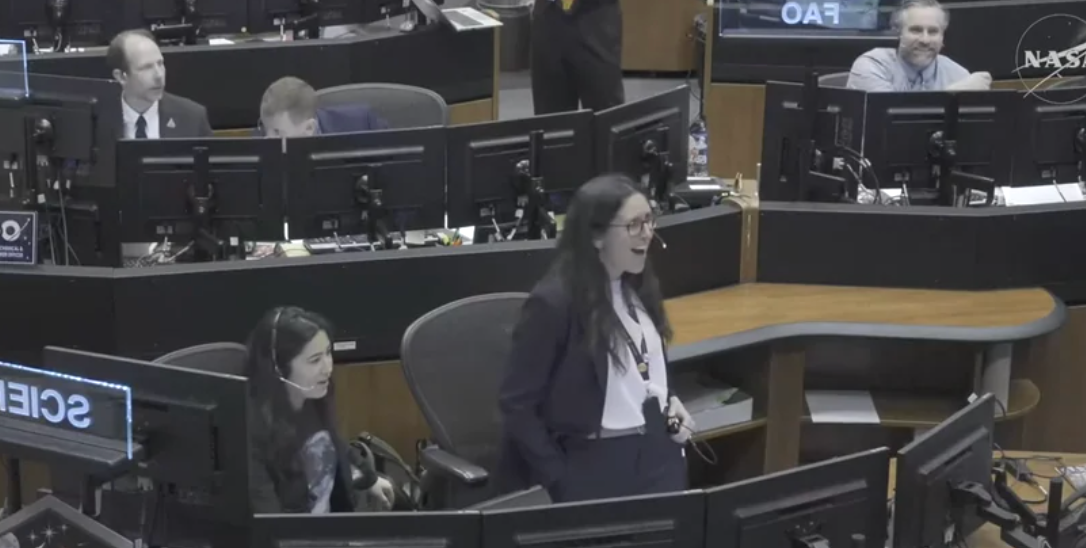
Here’s a screenshot of Dr. Kelsey Young, NASA geologist, planetary science specialist, and Artemis Science Flight Operations Lead, reacting as the astronauts describe meteorites impacting the far side of the moon.
And of course, there was Jacki, who gave us the phrase that now feels like the title of the whole experience: “Copy, moon joy.” There’s even a movement online to get it written in her handwriting so people can have it tattooed. They want a way to bring “moon joy” into their everyday lives.
Maybe so many people were drawn into the mission because it reached beyond the astronauts and the teams on the ground and into ordinary life. With Leah’s steady narration in the background, people followed along from kitchens, desks, couches, and treadmills, fitting space travel into the middle of regular Tuesday things. Again and again, it reminded us how many people it takes to make something extraordinary happen.
I keep thinking about a comment Jeremy made while in space: “To get big things done, you need a big team behind you. Share your dreams with others.”
We often talk about big ideas as if they belong to one visionary person. This mission kept showing how untrue that is. Someone has to be brave enough to say the dream out loud, and then a whole team has to decide, day after day, to help make it real. The courage of the crew was remarkable. So was the work of the thousands of people on the ground. The crew seemed to understand that they were carrying all of that effort with them, from the people who built the systems and guided the mission to those who narrated the story, planned the recovery, supported them at home, and helped imagine what might float in zero gravity.
I think about that in schools all the time. A mission is never only the idea itself. It is the daily choices of many people making the idea real.
So much of what we do in schools asks us to be serious. The stakes are real. Enrollment is real. Finances are real. Achievement is real. Strategy, data, and execution matter. People also need to see and feel what all of that effort is for.
Of course schools need programs, outcomes, dashboards, and plans. But a school’s purpose is usually felt in smaller ways: when a family feels known, when a student is seen clearly, or when a year-end tradition suddenly means more than anyone expected. The end of the year is full of those moments, even when everyone is tired and moving too quickly to notice them.
That is where Artemis felt unexpectedly connected to schools for me. The mission gave us the math and the engineering, the return through fire, and “Copy, moon joy.” It gave us ambition and precision, but also affection, play, and trust. It made something vast feel shared.
I think schools need that combination, too. Seriousness that still has warmth in it. A clear mission that people can feel, not just understand. Work that is careful and disciplined, but leaves room for joy.
I have always had a soft spot for the Moon. When I studied abroad in college, I remember writing letters home and telling friends to look up at it, because it was the same Moon I could see from wherever I was. Following Artemis brought that feeling back to me: the strange comfort of remembering that we are all looking up at the same thing.
Wishing you well as you wrap up the year.
